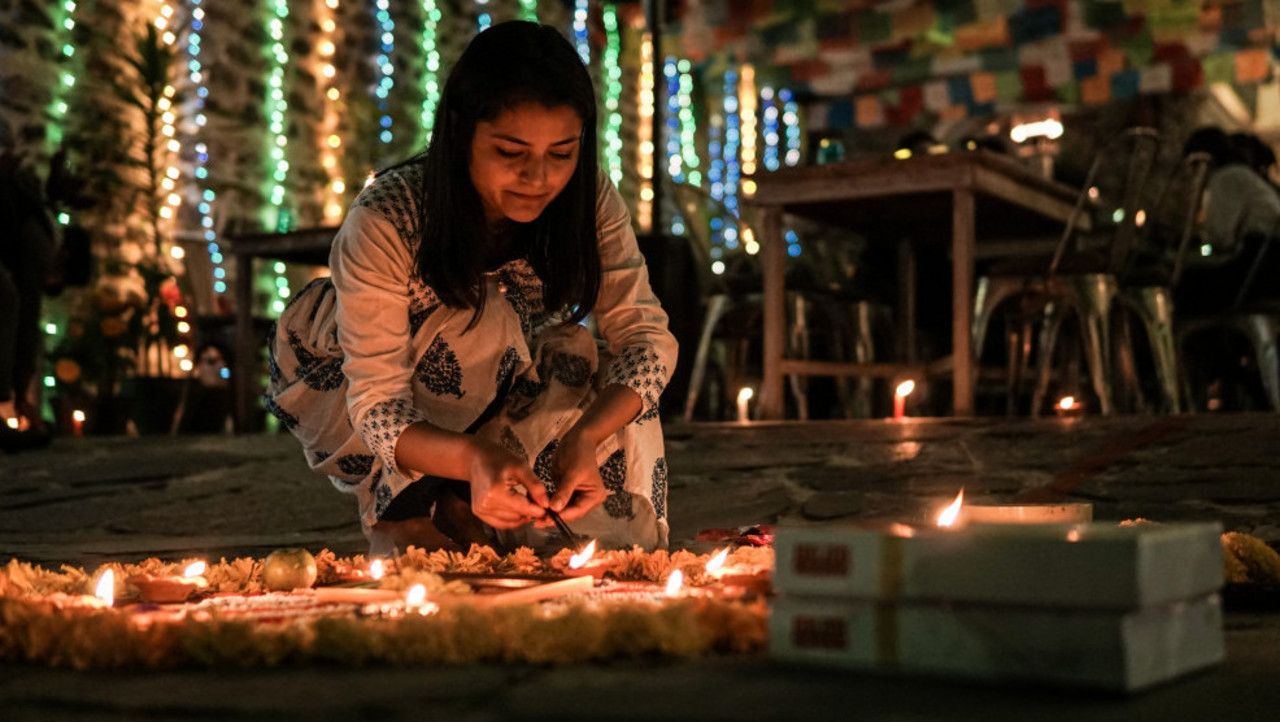
Tihar, also known as Deepawali or Yamapanchak, is one of Nepal’s most vibrant and significant festivals, Celebrated for five days in late autumn. While the geography differs, the soul of Tihar deeply resonates with the spirit of a European Christmas. It is a time when the mundane is swept away to make room for the divine, honouring not just the gods but also animals, nature, and the beautiful, resilient bonds of family.
Day 1: Kaag Tihar (Crow Tihar)
The festival begins by looking toward the sky. On the first day, crows are worshipped as the clever messengers of Yamaraj, the God of Death. In Nepali folklore, crows are believed to carry messages between the living and the spirits of ancestors. Rather than shooing them away, people prepare delicious food and leave it on rooftops or open spaces. It is a day of appeasement and respect, ensuring that the news brought in the coming year is fortunate.
Day 2: Kukur Tihar (Dog Tihar)
The second day is a favourite for animal lovers worldwide. It is dedicated entirely to dogs, honouring their ancient bond with humanity as guardians and loyal companions. According to Hindu mythology, dogs guard the gates of the afterlife. On this day, every dog—whether a cherished pet or a stray on the street—is treated like royalty. They are draped with garlands of marigolds (malla), marked with a red tika on their foreheads as a sign of sacredness, and fed special treats.
Day 3: Gai Tihar and Laxmi Puja
The third day is the festival's zenith. In the morning, the Cow (Gai) is worshipped. In Nepal, the cow symbolises motherhood and prosperity; she is fed the best grass and worshipped with garlands. As dusk falls, the atmosphere transforms into Laxmi Puja. This evening is dedicated to Laxmi, the Goddess of Wealth and Prosperity. It is believed that the Goddess only enters homes that are clean and bright. Consequently, families spend days cleaning every corner of their homes. At night, they light traditional oil lamps (diyos) and candles in doorways, windows, and rooftops to guide the Goddess inside. Intricate, colourful patterns called Rangoli are painted on the floors to welcome her.
Day 4: Govardhan Puja / Goru Tihar / Mha Puja
The fourth day honours physical labour and the self.
- Goru Tihar: The Ox (Goru) is worshipped for its vital role in agriculture, acknowledging the hard work that puts food on the table.
- Govardhan Puja: Devotees make small mounds of cow dung to represent the Govardhan Mountain, symbolizing the connection between earth and the divine.
- Mha Puja: For the indigenous Newar community of the Kathmandu Valley, this day marks the Nepal Sambat (New Year). They perform Puja—literally “worship of the self.” It is a profound ritual where family members sit in a row and worship their own bodies and souls, purifying themselves for the year ahead.
Day 5: Bhai Tika
The festival concludes with its most emotional day, celebrating the bond between brothers and sisters. Legend says that a sister once won a debate with the God of Death to protect her brother's life, making him immortal for a day. Reenacting this protection, sisters apply a special Saptarangi Tika (seven-colored vertical line) to their brothers’ foreheads. They place a garland of Makhamali (Globe Amaranth) flowers around their necks; this flower represents longevity because it does not wilt or fade. In return, brothers pledge to protect their sisters and exchange gifts and money.
Echoes of Christmas in the Himalayas
Though separated by thousands of miles, the traditions of Tihar and the Czech Christmas share a common “cultural soul.”
- The Victory of Light - Just as Czech towns light the first candle on the Advent wreath and decorate trees with lights to dispel the winter darkness, Nepal glows with thousands of oil lamps and electric lights during Tihar. Both festivals use light to symbolize hope, the victory of good over evil, and the warmth of home during the colder months.
- Caroling: Deusi-Bhailo and Koleda - During Tihar, groups of children and young people go from house to house singing traditional songs called Deusi and Bhailo. They tell the ancient story of King Bali and bless the household with prosperity. In return, the house owners give them money and sweets. This is strikingly similar to the Czech tradition of Koleda (carolling) on St. Stephen’s Day or Three Kings' Day, where carolers visit neighbours to sing and receive treats.
- The Feast: Sel Roti and Cukroví - No festival is complete without specific flavors. In Nepal, the signature treat is Sel Roti, a ring-shaped, deep-fried rice doughnut made from rice flour, sugar, and butter. Families spend days making these to share with neighbors. This mirrors the Czech tradition of baking Cukroví (Christmas cookies) or braiding the Vánočka. In both cultures, the act of preparing these sweets is a communal family event, and sharing them is a gesture of love.
- The Decor: Marigolds and Evergreen - While Czech homes are scented with pine needles and purpura, Nepalese homes smell of marigolds and incense. The use of nature to decorate the home is central to both. The bright yellow marigold garlands hung on Nepalese doors serve the same welcoming purpose as the Advent wreath or mistletoe on a Czech door.
- The Spirit of Generosity - Ultimately, both Bhai Tika and Christmas Eve are about renewing bonds. Whether it is a brother giving a gift to his sister in Kathmandu, or a family exchanging gifts by the tree in Prague, the sentiment is identical: gratitude for the people who make our lives complete.
The essence of life and celebration expands far beyond boundaries. Festivals like Tihar and Christmas may wear different clothes, but they share the same heart—lights, gifts, sweets, songs, and, above all, love. No matter where people are from, the most important thing is the smile these festivals bring.
Merry Christmas and Happy Tihar.
The Ambassador Program of the Welcome Office is an initiative that enables international students at Palacký University Olomouc to engage across all faculties, offering peer support in academic matters, university integration, and cultural exchange. Ambassadors assist fellow students in navigating their studies, adapting to university and city life, and fostering a vibrant multicultural environment. They actively participate in cultural days and events, share best practices, collaborate on projects, and share their academic and personal experiences. Ambassadors also organize social events and facilitate effective communication between students, faculties, and the rectorate of Palacký University. If you are interested in seizing the opportunity to become our next ambassador, you can register here.